What disappeared from the web — and who is speaking now?
A provenance-first map of endangered Belarusian digital heritage and contemporary Belarusian-language voices: archives, podcasts, video, music commentary, short-form creators, and learning resources.
- 0
- verified seed records
- 0
- media and archive types
- 10
- mapped historical events
- 2
- interface languages
This is a curated seed index and functional search interface — not yet a comprehensive archive or an autonomous AI researcher.
See the method ↓One door into a scattered cultural web.
Search across formats and topics without erasing the original source. Every result opens the creator, publisher, museum, or directory that made it available.
0 records found
Descriptions are concise research annotations. Ownership remains with the linked sources.
No record matches all filters.
Try a broader topic or remove one filter. The index will grow through verified community suggestions.
Suggest the original source. Nothing is copied into the index without a visible link, status, and research note.
Two modules. One evidence trail.
MAPA · Belarusian lands through time
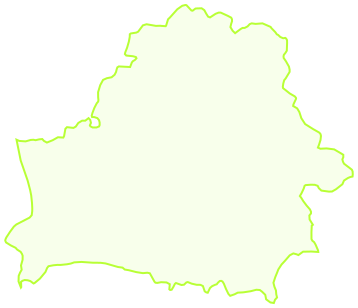
Which states governed the lands of present-day Belarus? Follow the chronology, compare territorial divisions, and inspect the historical sources. The modern outline is an orientation reference, not an ancient border.
- Map and table views
- English and Belarusian notes
- Source links and data export
Belarusian Voices Directory
A source-visible route to podcasts, video, short-form language creators, cultural commentary, museums, and learning resources across platforms.
- Multi-format search
- Belarusian and English interface
- Direct links to original publishers
The same lands. Different states.
Explore which states governed the lands of present-day Belarus, including periods of division. Keep the modern outline as a reference, or switch to the wider region. Inspired by Alexey Cherenkevich and the original MAPA team.
 1067156919181991
MAPA ↗
1067156919181991
MAPA ↗
- Original
- The Interactive Map of Belarusian History · map.letapis.by
- Use it now
- Choose a historical date, read the territorial affiliation, and compare places. Use the regional view for surrounding states and the source notes for limits and disputed detail.
- Current coverage
- A sourced chronology with territorial views and place checks, plus ten historical events. Dates with mapped geometry are distinguished from context-only transitions.
- About this edition
- A new implementation with independently sourced history and openly licensed geometry. It does not restore all 63 original maps. Unresolved boundaries and differences between sovereignty, occupation and claims remain visible.
Original project credits
Alexey Cherenkevich (Аляксей Чаранкевіч)idea and design
Yauhen Shpileuski (Яўген Шпілеўскі)front-end
Hanna Shyrayeva (Ганна Шыраева)texts and translations
Viktar Yakunin (Віктар Якунін)management
Pavel Kedzich (Павел Кедзіч)advice
Follow every entry back to its source.
Use this directory to discover a resource, then read or listen on the original publisher’s page. Our short annotations explain what you can find there; the map adds independently written historical context.
- 01
Find
Locate the original source, live page, archive capture, or creator documentation.
- 02
Verify
Separate what the source proves from what remains an inference or research lead.
- 03
Credit
Name the original creators and link to their surviving pages before adding interpretation.
- 04
Ask
Request written permission before mirroring or adapting protected content.
- 05
Connect
Turn approved material into searchable context and provenance-aware research records.
Status language used across the atlas
Original workLinked directly to its creator or publisher.
Attributed recordOur annotation about a source; the source is not copied.
Independent reconstructionNew research work based on verifiable facts, clearly separated from the original.
Permissions pendingIdentified for preservation, but protected material is not publicly mirrored.
Ask the people who built the culture where the gaps are.
The next review will invite cultural practitioners — including Siarhei Budkin, Volia Broman, and other domain experts who choose to participate — to identify missing archives, creators, genres, regions, and ethical risks. Their participation is not presumed.